
The promise of offshore hiring is often presented through one number: the monthly salary.
For a growing business, that number can be compelling. Hiring in the Philippines or another global talent market may offer access to strong professionals at a meaningfully different cost from hiring locally in the UK, the US or Australia.
That cost advantage is real. But the lowest advertised monthly rate does not always represent the full cost of the hire.
A salary sits inside a wider working system. Recruitment, equipment, onboarding, training, management time, quality control and retention all influence what the business ultimately spends and what it receives in return.
This does not mean the most expensive candidate is automatically the best. It means offshore hiring costs should be assessed in relation to the work, the level of support required and the outcomes the business needs.
Outsourcing shouldn't mean lowering your standards. It should mean applying those standards to a wider talent market.
What Actually Goes Into Offshore Hiring Costs?
The cost of hiring offshore employees or contractors begins with compensation, but it rarely ends there.
A practical budget may need to account for several elements:
- Compensation: Pay that reflects the role, experience, responsibilities, working hours and local market.
- Recruitment: Advertising, sourcing, interviews, assessments, reference checks and the internal time spent selecting the right person.
- Equipment and connectivity: A suitable laptop, peripherals, reliable internet and any security requirements specific to the work.
- Software: Licences for communication, project management, finance, CRM, design or other role-specific tools.
- Onboarding: Time spent explaining the business, customers, standards, systems and decision-making processes.
- Training: Initial role training, process documentation and ongoing professional development.
- Ongoing management: Meetings, feedback, quality checks, coaching and support from the business owner or team leader.
- Administration: Contracts, payments, compliance considerations and any support provided by a recruitment or outsourcing partner.
Some of these are direct offshore staffing costs. Others appear as time taken away from sales, customers, leadership or delivery.
Neither category is inherently negative. Every new hire needs context and support. The important question is whether the level of investment is appropriate for the capability being added.
The Hidden Costs of Hiring Solely on Price
A low monthly salary can look efficient on a spreadsheet. Problems begin when price is treated as the only meaningful measure of value.
If the role requires judgement but the person is hired for basic task execution, the business may absorb the difference through additional supervision. Instructions become more detailed. Work is checked more often. Decisions continue to return to the founder.
Rework is another hidden cost of outsourcing. A task completed quickly but incorrectly may need to be corrected by someone more experienced. A missed follow-up may delay a sale. An inaccurate report may weaken a decision. A poorly managed process may create work for several people, not just one.
Misaligned expectations can also affect retention. If a role is advertised as administrative but carries specialist responsibilities, the person may struggle or leave. The business then pays the offshore recruitment costs again and repeats the onboarding process.
None of this is an argument against affordable talent. It is an argument for matching the person, expectations and support model to the real complexity of the work.
The cheapest hire can become expensive when the business must supply all the missing judgement, structure and ownership.
Why Experience Changes the Economics
Experienced professionals do not remove the need for onboarding. They still need to understand your customers, systems and priorities.
What experience can change is the quality of contribution after that context is provided.
A capable marketing professional may notice that campaign reporting is inconsistent and propose a better workflow. An operations coordinator may identify where customer requests are being lost. A finance specialist may question a discrepancy before it reaches a management report.
That value is difficult to capture through a salary comparison alone. It appears through better questions, earlier problem-solving, clearer communication and fewer avoidable mistakes.
Experience can also reduce dependency. Rather than waiting for every instruction, the professional can begin to own recurring outcomes, recommend improvements and recognise when something should be escalated.
This is the distinction between adding another pair of hands and building capability through offshore hiring.
For SMEs with limited management capacity, that difference matters. A lower-cost hire who needs several hours of founder supervision each week may offer less total value than an experienced professional who can progressively take ownership.
How AI Is Changing the Value of Offshore Talent
AI is changing the economics of professional work. It can accelerate research, organise information, support first drafts, automate repetitive steps and make many workflows more efficient.
But access to an AI tool is not the same as professional capability.
Someone still needs to frame the problem, provide context, assess the output, protect confidential information and decide what is appropriate for the business. Weak judgement can produce weak work faster. Strong judgement can use the same technology to create better results with less friction.
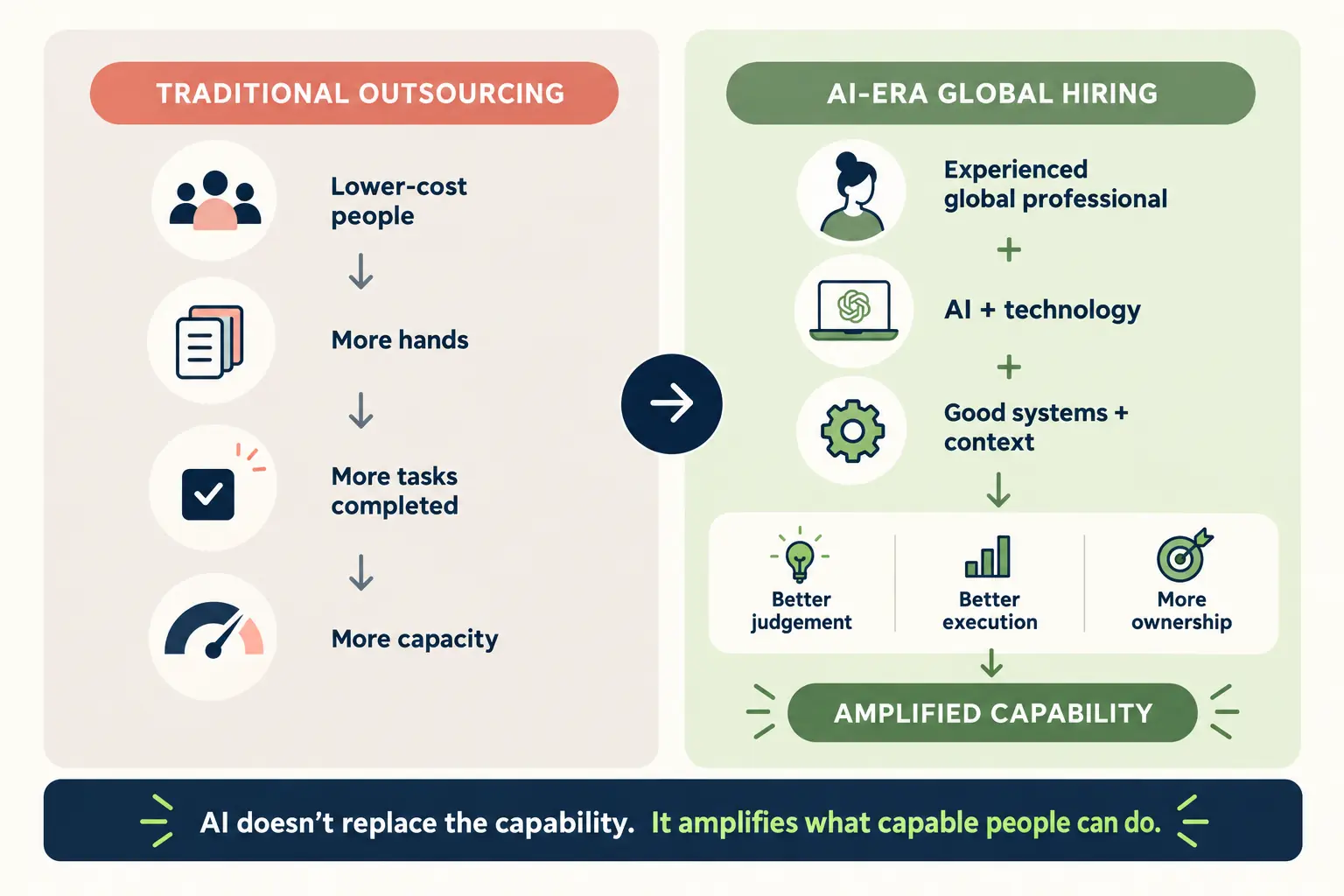
The stronger model combines an experienced professional, suitable AI tools and good systems. The technology handles more of the repetitive work while the person applies judgement, communicates with stakeholders and improves execution.
That is why AI-ready offshore talent should be assessed on practical application, not simply whether a candidate knows how to write prompts.
AI does not replace capability. It amplifies what capable people can do.
When a Lower-Cost Hire Makes Perfect Sense
Not every role needs a highly experienced specialist.
A junior or entry-level professional can be an excellent choice when the work is clearly defined, the processes are stable and the business has time to provide guidance. Structured data entry, list building, routine administration, file organisation and documented support tasks may be suitable examples.
Junior Filipino professionals should not be assumed to be less capable. They may be talented, reliable and ready to grow. The difference is often the amount of professional experience they have had the opportunity to build, not their potential.
A lower-cost hire is most likely to succeed when:
- The tasks and quality standards can be explained clearly.
- There is a manager available to train and answer questions.
- The role does not depend heavily on independent commercial judgement.
- The business has documented processes and realistic expectations.
- There is room for the person's responsibilities and compensation to grow with their capability.
The mistake is not hiring at a junior level. The mistake is expecting senior-level ownership from a role designed and priced for basic execution.
How to Compare Offshore Hiring Options
When comparing candidates, direct hiring services or outsourcing partners, look beyond the headline monthly rate. Ask how each option affects the total cost of achieving the outcome.
- Total cost: What is included beyond compensation, and what will the business need to provide separately?
- Relevant experience: Has the candidate handled comparable responsibilities, systems or international stakeholders?
- Management requirement: How much instruction, checking and coaching is realistic for this level of hire?
- Quality and judgement: Can the person explain how they solve problems, verify work and make decisions?
- Productivity: Do they use appropriate tools, including AI, to improve workflows without sacrificing accuracy?
- Role clarity: Are the responsibilities, outcomes and boundaries clearly defined?
- Onboarding support: Who will provide context, documentation, feedback and access to the right people?
- Retention: Are the compensation, working hours and expectations sustainable for the person being hired?
- Long-term value: Can the role develop from task support into stronger ownership as trust and experience grow?
It may help to compare options using two columns: what you pay and what the business must still contribute. A lower fee may require more recruitment work, equipment, training and management. A higher managed cost may include some of those elements.
Transparency matters. Ask for a clear explanation of compensation, fees, responsibilities and ongoing support before making the decision.
Hire for Capability, Not Just Capacity
Offshore hiring gives growing businesses access to a much wider talent market. The cost advantage can be meaningful, especially for SMEs that are not ready to build every function locally.
But the opportunity is bigger than finding the lowest-cost person available.
It is the opportunity to identify what the business is missing and find a professional who can help build it. That might be more consistent marketing execution, better organised operations, stronger customer coordination or more dependable finance reporting.
When hiring experienced Filipino professionals, assess their evidence of ownership, communication, judgement and international working experience. Then create the context and systems that allow those qualities to translate into results.
The smartest offshore hiring decision is not necessarily the cheapest. It is the one that delivers the right capability, at a sustainable total cost, with value that can grow over time.