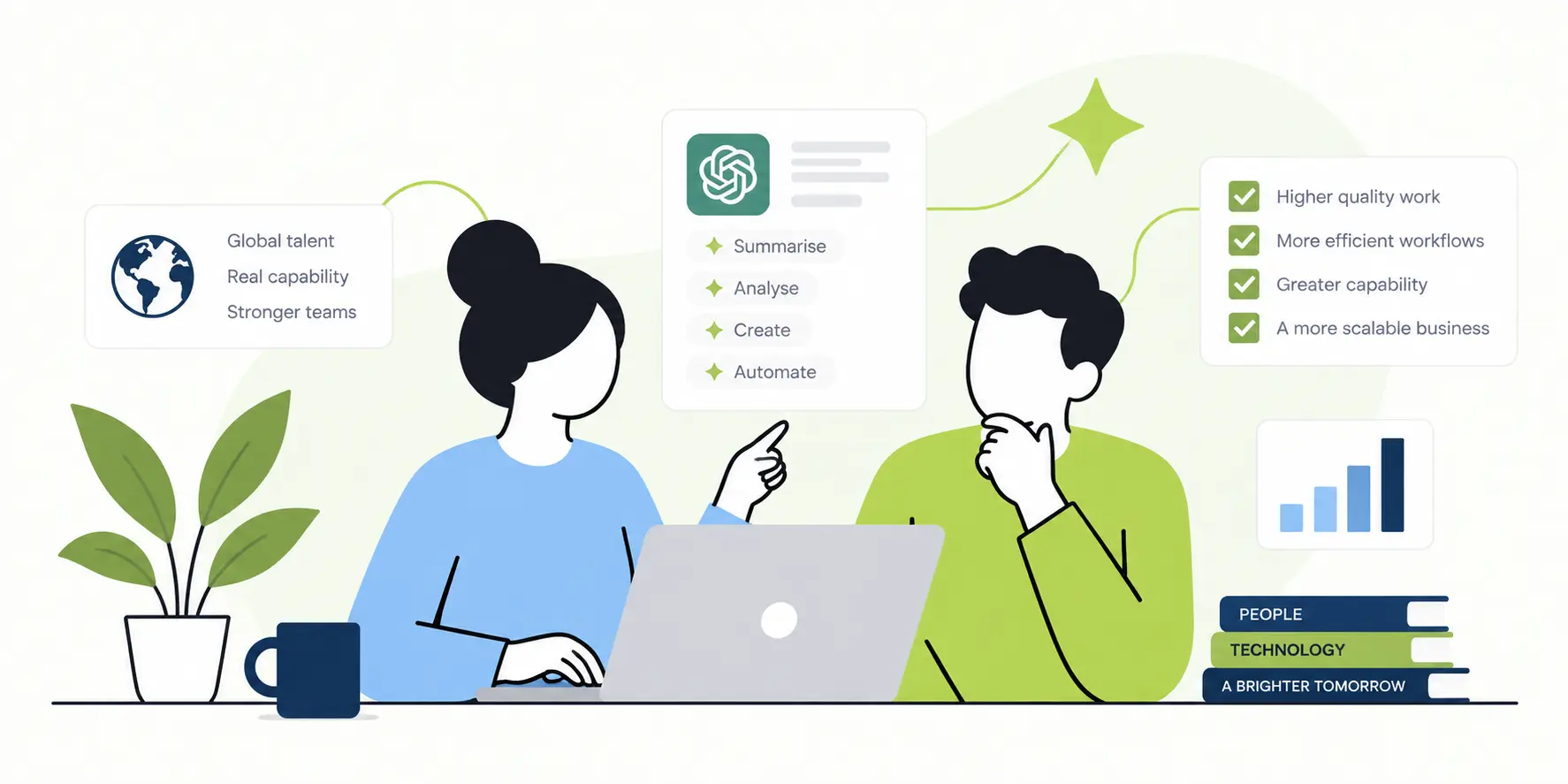
AI is changing the way we work.
But perhaps one of the biggest opportunities for growing businesses isn't simply adopting more AI tools.
It's having the right people who know what to do with them.
For SMEs, this creates an interesting opportunity.
Businesses can now access experienced professionals globally while giving those people technology that helps them research faster, automate repetitive work, organise information, analyse data and improve workflows.
The result isn't simply cheaper work.
Done well, it can mean more capability than a business could previously access at the same stage of growth.
That's where we believe the conversation around offshore talent is heading.
From offshore capacity to offshore capability
For years, outsourcing has largely been discussed in terms of capacity.
You have too much work. You hire someone offshore. They take some of it away.
There's nothing inherently wrong with that model. Sometimes a business genuinely does need another pair of hands.
But the opportunity can be much bigger.
Instead of asking:
“What tasks can I send offshore?”
We think businesses should start asking:
“What capability does my business need next?”
Perhaps your marketing campaigns keep stalling because nobody owns the operational side of marketing.
Maybe client requests, calendars, documentation and recurring admin keep finding their way back to senior people.
Or perhaps you have plenty of financial information but nobody consistently turns it into useful reporting.
Those aren't simply task problems.
They're capability gaps.
And increasingly, global talent combined with AI gives smaller businesses another way to fill them.
For a deeper look at the distinction, read Capacity vs Capability: A Better Way to Think About Offshore Hiring.
So, what does “AI-ready talent” actually mean?
It doesn't mean hiring someone who knows how to open ChatGPT.
Most people can do that.
AI-ready talent is someone who understands their role well enough to recognise where technology can make the work better.
There's an important difference.
Imagine you hire someone to support your marketing operation.
At the most basic level, they might execute the tasks they're given.
A stronger professional takes ownership of those tasks and makes sure the work gets done.
An AI-ready professional can go further.
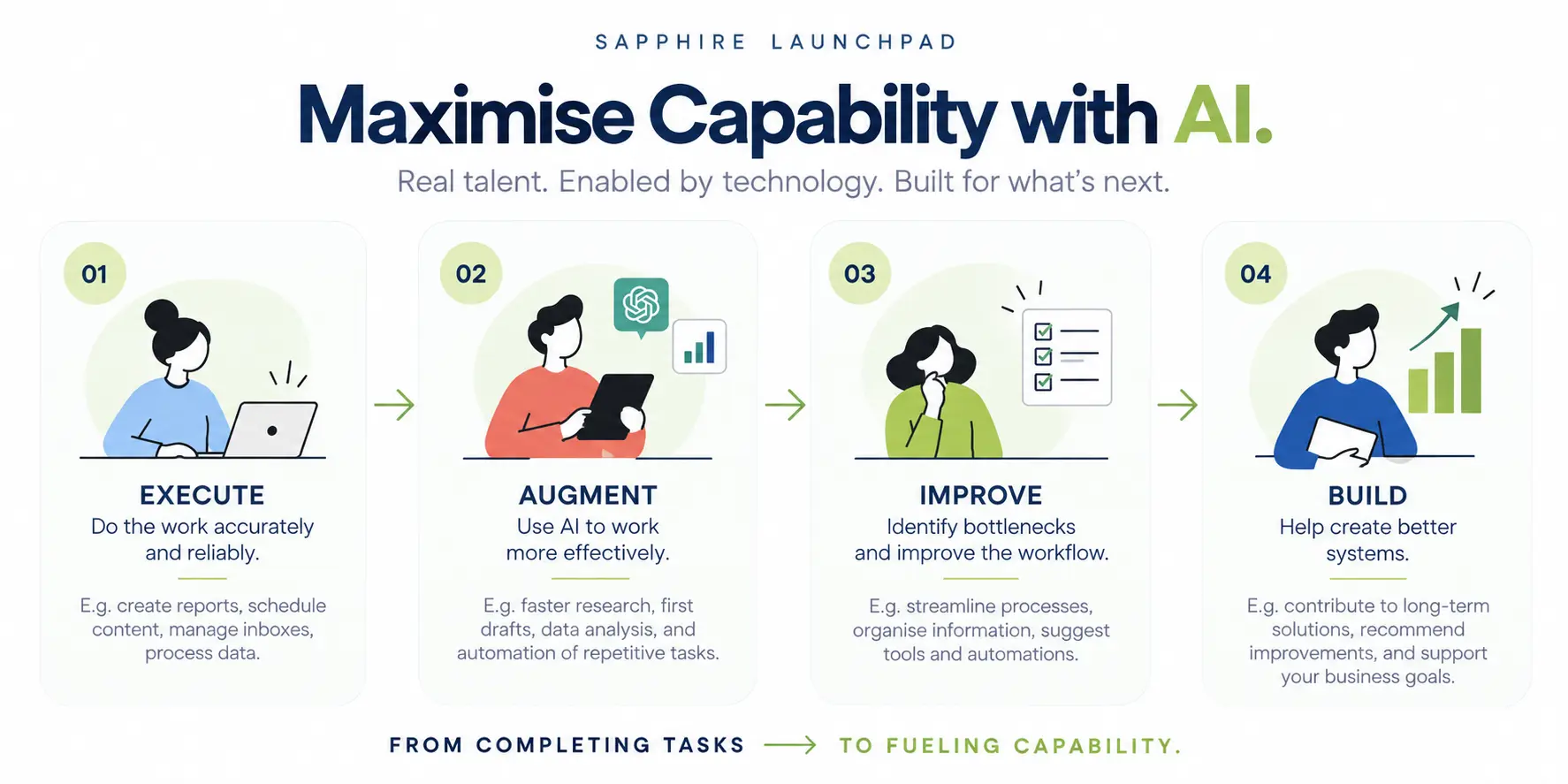
The progression might look something like this:
- Execute the taskThey complete the work accurately and reliably.
- Use AI to work more effectivelyThey use appropriate tools to accelerate research, organise information, create first drafts or reduce repetitive manual work.
- Improve the workflowThey notice unnecessary steps, recurring bottlenecks and opportunities for automation.
- Help build a better systemOver time, they don't just operate within the process. They help make the process itself stronger.
That final stage is where things become particularly interesting for SMEs.
You're no longer just buying someone's time.
You're building capability.
AI creates leverage. People turn it into outcomes.
There's understandable excitement around what AI can automate.
But technology still needs context.
A tool doesn't inherently know why a particular client needs extra attention, whether a piece of information looks unusual, when something should be escalated, or how your team prefers to communicate.
Good professionals bring the human layer:
judgement, context, communication, accountability and ownership.
AI can then amplify what they're able to do.
Think about a few common SME roles.
A Marketing Operations Coordinator might use AI to accelerate research and reporting while taking ownership of campaign timelines, CRM hygiene and the moving pieces behind your marketing.
An Operations Coordinator might use automation to reduce repetitive administration while managing schedules, documentation, client workflows and recurring processes.
A Finance Data & Reporting Specialist might use AI-assisted tools to organise information or identify patterns while maintaining the human oversight needed to ensure reporting is dependable and useful.
The technology doesn't eliminate the need for capable people.
It can make capable people more capable.
Why global talent makes this especially interesting for SMEs
Large organisations have historically had an advantage when it comes to capability.
They can build specialised departments, hire people for narrower functions and invest heavily in technology and systems.
Smaller businesses have had to make different choices.
One person might handle marketing, operations and client communication. Founders often become the final escalation point for everything. Senior employees end up doing work that doesn't really require their level of experience simply because nobody else owns it.
Global hiring changes some of those economics.
A growing SME doesn't necessarily have to wait until it can build a large local department before strengthening a particular function.
Experienced professionals in markets such as the Philippines can become part of international teams and take ownership of meaningful areas of the business.
Combine that with increasingly accessible AI and automation tools, and SMEs have the opportunity to build sophisticated ways of working earlier in their growth journey.
That's a much more interesting proposition than simply asking where labour is cheaper.
But AI doesn't fix a bad hire
There's another side to this conversation.
Giving someone access to AI doesn't suddenly create good judgement, communication or accountability.
And automation applied to a broken process can simply make the broken process happen faster.
The fundamentals still matter.
You need someone with the right capability for the role.
They need to understand what success looks like.
They need appropriate access to information and tools.
They need clear ownership.
And they need to understand how their work connects to the wider goals of the business.
That's why we don't believe the future of outsourcing is simply people + more technology.
The right people + the right technology + clear ownership.
What should remain human?
Not everything should be automated.
In fact, becoming AI-ready also means knowing when not to use AI.
Businesses still need human judgement around relationships, sensitive decisions, quality control, strategy, leadership and situations where context matters more than speed.
The goal shouldn't be to remove humans from every process.
It should be to remove unnecessary friction from the work humans are doing.
When repetitive administrative steps can be automated, people have more room to think.
When information can be organised faster, people have more time to interpret it.
When first drafts can be created quickly, people can spend more time improving the final result.
That's the kind of leverage we find interesting.
A different way to think about your next hire
Before creating another job description, try asking a slightly different set of questions.
- What keeps landing back on your desk?
- Where does work regularly stall?
- What information do you constantly have to chase?
- What processes depend too heavily on one person?
- What capability would make the rest of your team more effective?
And then:
Could the right professional, supported by the right technology, own that capability?
That question may lead to a very different role than simply listing all the tasks you want to get rid of.
The future of offshore work shouldn't be about cheaper people
At The Good Outsourcing Co., we believe global hiring has the potential to be much more than a cost-saving exercise.
The Philippines has a deep pool of professionals who already work with businesses around the world.
AI now gives those professionals, and the companies they work with, an entirely new set of tools.
Put the two together thoughtfully and the opportunity isn't simply to do the same work somewhere cheaper.
It's to build stronger systems, better-supported teams and capability that lasts.
That's the kind of offshore model we want to help build.
Built in the Philippines. Experienced globally.