For decades, one of the easiest ways to explain outsourcing was also one of its biggest selling points:
Access people somewhere else who can do the work for less.
It helped build an enormous global industry.
But AI is starting to challenge that equation.
And that might be a good thing.
In September 2026, Concentrix CEO Chris Caldwell said the company had reached what he described as an “inflection point”: 50% of its revenue was coming from business won and deployed within the three years since the introduction of AI.
Perhaps even more interestingly, Caldwell said Concentrix was “aggressively disrupting” its own traditional business, while pointing to stronger underlying new business, margin expansion and growth in newer services.
Source: Concentrix, Q3 2026 Results
That is a significant statement from one of the world's largest technology and services companies.
But for SME leaders, the important question isn't what this means for Concentrix.
It's:
What does AI change about the way you build your own team?
The old outsourcing equation is becoming less useful
Traditional outsourcing has often been framed around a fairly straightforward calculation:
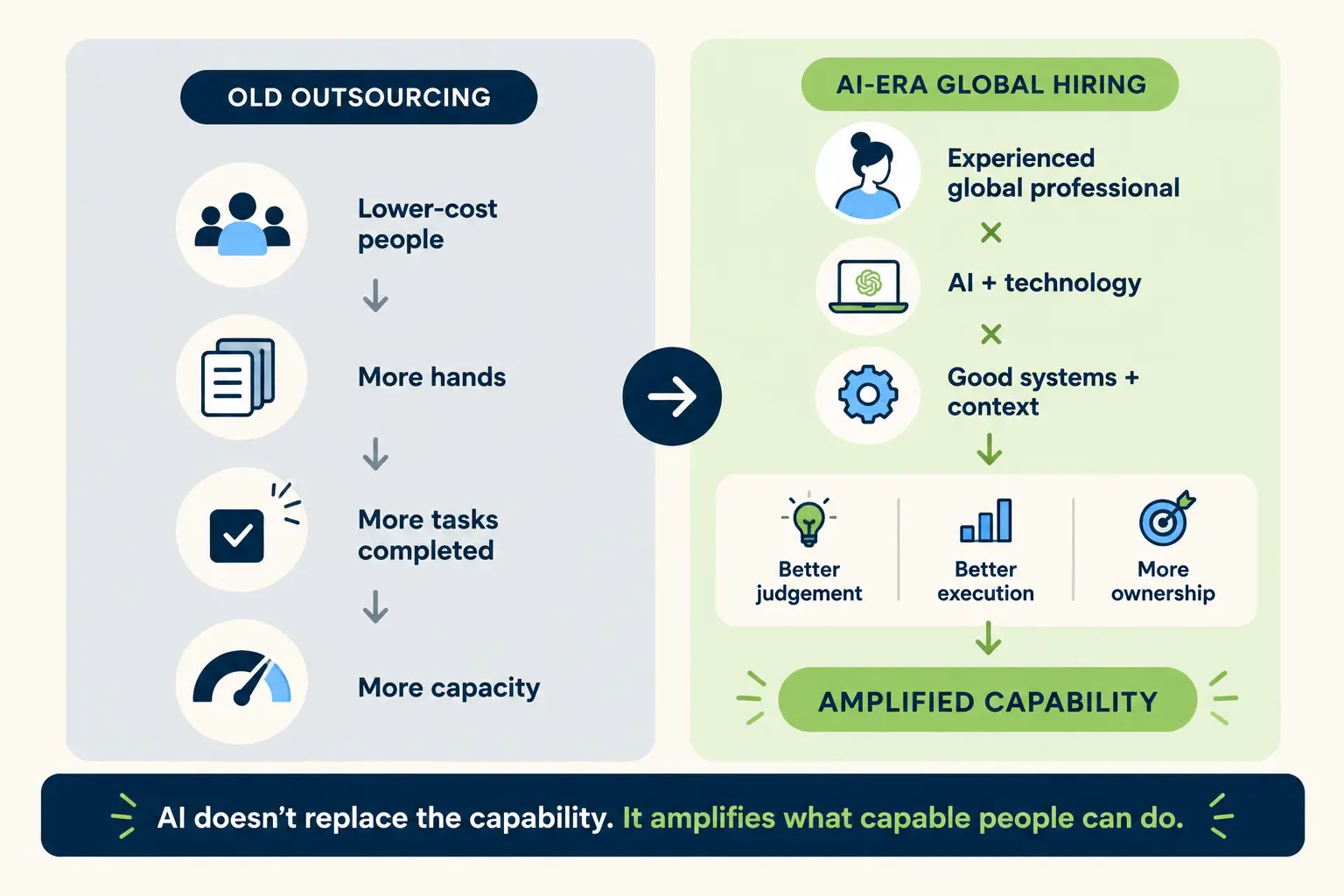
More people + lower labour cost = more capacity
There will continue to be situations where additional capacity is exactly what a business needs.
But AI makes another question increasingly important.
If technology can research faster, draft faster, analyse more information, automate repetitive processes and accelerate routine execution, should businesses still be hiring people primarily for their ability to complete those tasks cheaply?
Probably not.
The value of the human starts moving elsewhere.
Towards judgement.
Problem-solving.
Communication.
Context.
Relationships.
Decision-making.
And perhaps most importantly:
That changes what businesses should be looking for when they hire globally. It also changes the conversation from simply adding capacity to intentionally building capability.
AI isn't the capability. The person still matters.
There is a tempting assumption that AI creates a choice between technology and people.
Hire someone.
Or:
Use AI instead.
For some tasks, that decision will absolutely make sense.
But anyone using AI seriously inside a business also knows that the technology isn't perfect.
AI needs context.
Outputs need checking.
Systems need designing.
Automations need monitoring.
Someone needs to recognise when something doesn't make sense.
Someone needs to understand the customer, the business, the objective and all the nuance that never quite makes it into the prompt.
And when something goes wrong, someone still needs to take responsibility for the outcome.
That is why we believe the more interesting equation is:
Experienced professional + AI + good systems = amplified capability
AI doesn't necessarily remove the need for capable people.
It can increase what capable people are able to accomplish.
Concentrix itself has described its approach as combining human and AI solutions, while separate research highlighted by the company in September argued that AI success increasingly depends on governance, accountability and execution across people, technology and teams, not simply deploying another AI tool.
Source: Concentrix, “Reinvent or Evolve? New Report Reveals the Two Paths to AI Success”
Maybe you don't need another AI tool
This is where things become particularly interesting for SMEs.
There has never been more technology available to a small business.
AI assistants.
Automation platforms.
CRMs.
Project management systems.
Analytics tools.
Content tools.
Finance software.
Another subscription is rarely difficult to find.
The harder question is:
Who is going to turn all of those tools into a better business?
Maybe the answer isn't another piece of software.
Maybe it's an experienced marketer who knows how to use AI to research faster, analyse performance, improve workflows and keep campaigns moving.
Maybe it's an operations professional who can document a messy process, identify what should be automated and then take ownership of what remains.
Maybe it's a finance professional who can combine good financial processes with technology to organise information and make reporting more dependable.
Maybe it's an executive support professional who doesn't simply manage a task list, but uses technology to create better systems around the executive they support.
The technology matters.
But so does the person using it.
This changes the global hiring conversation
Historically, many businesses started their offshore hiring journey with a question like:
What tasks can I send offshore?
That naturally leads towards task-based hiring.
Make a list.
Find someone who can execute it.
Transfer the work.
Measure the hours.
AI gives SMEs an opportunity to start somewhere different.
Instead of asking:
“What tasks can I send offshore?”
Ask:
“What capability does my business need next?”
Perhaps you need stronger marketing execution.
Better financial visibility.
Someone to own recurring operations.
More consistent client follow-up.
Better documentation.
A leader who desperately needs breathing room.
Once the business gap is clear, then you can ask what combination of human experience, technology and systems could solve it.
And only then:
Where in the world can I find the right person?
Does your next hire actually need to live where you live?
This might be one of the most useful questions an SME leader can ask before publishing their next job advertisement.
Not:
“Can I find someone cheaper overseas?”
But:
“Does the best person for this role actually need to be geographically close to me?”
If the work can be done remotely, your available talent pool changes dramatically.
An experienced marketing professional in the Philippines doesn't stop being a marketing professional because they work remotely.
Neither does an accountant, operations specialist, executive support professional, designer or analyst.
Their location changes.
Their professional capability doesn't disappear.
That is why it is worth looking beyond the catch-all VA label and hiring for the actual profession and capability your business needs.
And when those professionals are equipped with modern technology and AI, the amount of value a single person can potentially contribute changes too.
This is why global hiring shouldn't simply be viewed as a labour-cost strategy.
It can be a capability strategy.
Before making your next hire, ask four questions
Before automatically replacing someone, adding another local role or buying another AI subscription, step back and look at the outcome your business actually needs.
- What outcome do I need someone to own?Don't start with the job title. Start with what's currently missing, breaking or consuming too much leadership attention.
- What parts of this work can AI accelerate?Look for research, drafting, analysis, documentation, repetitive administration and other areas where technology can increase productivity.
- Where do I still need human experience and judgement?Consider context, communication, decision-making, quality control, relationships, problem-solving and accountability.
- Does this person actually need to live where I live?If the answer is no, don't unnecessarily restrict your talent search by geography.
Look for the capability first.
Cheap labour shouldn't be the future of global work
There is a bigger reason we think this shift matters.
Countries such as the Philippines have spent decades building deep pools of professionals with experience supporting businesses around the world.
The opportunity shouldn't be to make those professionals compete with AI over who can complete a repetitive task more cheaply.
The opportunity should be to help them use AI.
Train them.
Give them better technology.
Give them context.
Trust them with meaningful responsibility.
Allow experienced people to move further up the capability curve.
Because the future of outsourcing doesn't have to be:
Humans versus AI.
And it shouldn't simply be:
Local people versus cheaper offshore people.
A much more interesting future is:
Experienced global talent × technology × good systems = stronger business capability.
AI may eventually eliminate parts of the traditional outsourcing model.
Some repetitive work will disappear.
Some roles will change.
Some teams may become smaller.
But that doesn't necessarily make global talent less valuable.
It may make capable, AI-ready global talent significantly more valuable.
And perhaps that's exactly the disruption this industry needs.